I remember that my father had borrowed a modem from work and brought it home. A central question, which I can no longer get an answer to, is why he brought it home.
I was allowed to use it for a few days, and I found out that one of my classmates had one too.
I can’t remember the circumstances behind how we worked out that one modem could get in touch with another through a terminal program either, but we did, and it was something other than talking at school, I liked it, the time-shift in replying.
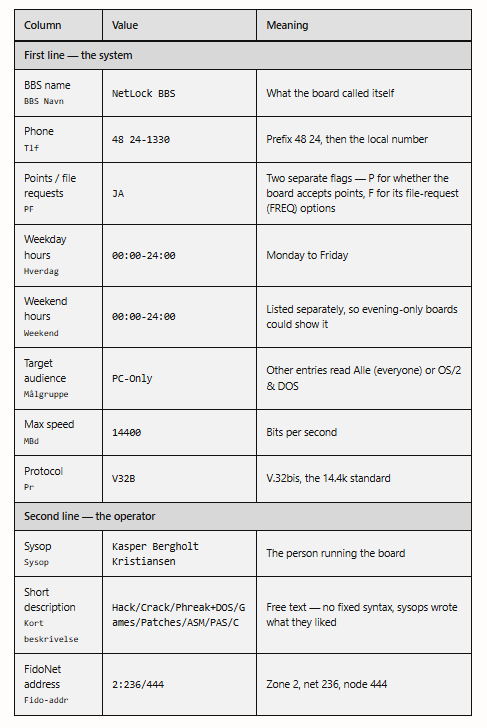
How I got hold of the phone number for the first BBS, I don’t know, but from there one thing led to another, and a few months later I launched my own BBS, NetLock BBS, which later became a FidoNet node in the Hillerød area, Denmark (around 40 kilometers from the capital of Copenhagen).
In the past, when I’ve spoken about having built, and I deliberately don’t write programmed, a BBS, one of Denmark’s earliest social media platforms, people have wondered why I didn’t go on to study computer science or something similar.
The answer, I think, is that the BBS wasn’t so much about programming things, excellent software was available for free, such as the Maximus BBS platform, for instance, it was more about setting up, choosing designs, curating and cataloging content, mostly in text form, and chatting with users. It did land me my first job in tech, though, in a small IT consultancy firm.
I remember being disappointed when a user suggested I shouldn’t write that I was 15.
And I remember chatting with someone called Signe, I’m fairly sure; but I’m completely sure that she sent me a (physical) photo, and I didn’t have the courage, I think, to send her one back; but I remember thinking she looked very cute.
—
Netlock BBS: Digital Archeology
NetLock BBS ran on Maximus, Scott Dudley’s package, powerful software, on a PC in a basement in Hillerød. PC-only (i.e. no Amiga, no Commodore 64), open around the clock, after we got a second phone line, 14,400 bps over V.32bis.
Maximus had a reasonable footing in the Danish scene at the time. Its source is now public under GPL, and the tree includes mec/, the MECCA compiler, the markup language in which the board’s menus and screens were actually written. If I remember correctly, I created small task-based modules in Turbo and, at a later stage, Borland Pascal too.
Earliest Days, Virus Attack, Getting Backup
My best guess is that NetLock ran as BBS-only for about a year before the official FidoNet node record marking joining the FidoNet network in 1994.
The earliest days were run on our main telephone number, and the calls made my mom frustrated and worried my grandmother wouldn’t be able to reach us in an urgent situation because the line registered as busy.
Today, I’m grateful my father chose to get us a second phone line just for the BBS. At a late stage, after all content, including the system files, of the BBS were wiped out by an uploaeded virus contained ina program, we went to Falkoner Alle to get a tape streamer, prior to that the board ran wihtout any backup as storage was simply too expensive.
Bad or Missing Command Interpreter
DOS was the first operating system I used. “Bad or missing command interpreter” was a message I encountered frequently, and it ran only one program at a time.
After that came OS/2 Warp, which Maximus BBS had been ported to. Warp let me run several programs at once, and because its multitasking was preemptive, one program locking up didn’t take the whole system down with it.
The FidoNet Node
NetLock held 2:236/444 from 8 July 1994 until removal from the nodelist on 23 February 1996, having been flagged Down three weeks earlier.
Net 236 was one of five Danish nets, consisting of 234, 235, 236, 237, 238, under Region 23.
| Date | Change |
|---|---|
| 8 Jul 1994 | First listed. Local prefix 42 26. Flags V32B, V42B, XA |
| 22 Jul 1994 | Prefix changes to 48 24; location string unchanged |
| 16 Sep 1994 | CM added — continuous mail |
| 6 Jan 1995 | Location becomes Hilleroed_DK |
| 26 Jan 1996 | Reverts to Hilleroed |
| 2 Feb 1996 | Marked Down |
| 23 Feb 1996 | Removed from the nodelist |
The prefix change a fortnight after listing was a renumbering, not a move; the location field never altered.
XA meant file requests were open to all callers. The nodelist speed field reads 9600 throughout while the Danish BBS list says 14400; this is not a contradiction.
The speed field was conventionally capped because older nodelist-processing tools rejected higher values, with actual capability expressed through the flags. V32B is the 14.4k one.
The end of the board sits inside a general collapse rather than being particular to it. The BBS market crashed from late 1994 into 1995 as cheap dial-up internet and graphical browsers arrived, and thousands of systems disappeared over the following year
Fridays
Every date in the table above is a Friday: 8 July, 22 July, 16 September 1994; 6 January 1995; 26 January, 2 February, 23 February 1996 – all seven..
That is the day the nodelist was published, which means not one of them is the day anything happened. Each records the first weekly list in which a change had already appeared.
Sources on NetLock BBS
I keep the records at exergue.
