Helena Christensen in Nepal
I remember watching Helena Christensen taking pictures during a trip in Nepal with a medium format camera from Pentax. At the time, I had no idea what I was looking at; I only knew the small film cameras everybody had.
In my memory this belonged to the 90s; records say otherwise: it was November 2010, when Christensen, supermodel, photographer and Oxfam Global Ambassador, travelled to Nepal to document what climate change was doing to the country’s most exposed communities.
In the Terai lowlands in the south, including villages in the Nawalparasi district, she photographed people whose harvests and homes were being taken by floods, cold waves and increasingly erratic weather.
The photographs from Nepal and Peru were later exhibited at the United Nations in New York, in Washington and London, and in 2012 gathered, with images from a third trip, to Kenya, in the booklet ‘Meltdown’, sent to heads of state at Rio+20.
In press photographs from the Peru trip the year before, she stands in a knitted chullo, the Andes dissolving behind her, working with a Pentax 67 II, a 90mm SMC-A f/2.8 mounted: 2.3 kilos with prism and standard lens, about the same heft as a Nikon D3 with a zoom attached. And out of production by the time she reached the Terai.
It’s tempting to trace Christensen’s preference back further, to Sante D’Orazio, who photographed her repeatedly in the early 90s and was among the photographers who built a reputation on the Pentax 67, though whether that’s where it started is a guess, not a fact.
In later photographs, from Kenya, she is holding a small Canon PowerShot, and ‘Meltdown’ includes Polaroids. Even a medium format devotee travels light now and then.
Also see: Objects for an Ideal Home
Using a modified Pentax 67 as director’s optical viewfinder
On a related note, Christopher Nolan was seen using used a modified Pentax 67 as the director’s optical viewfinder during his work on The Odyssey.
The choice makes sense dimensionally, because the the Pentax 6×7 negative measures around 56 × 70 mm, close to the IMAX camera aperture of about 52.6 × 70.4 mm.
Technology From a More Civilised Age #1
Rocks, and Stones, and Trees, Tisvilde
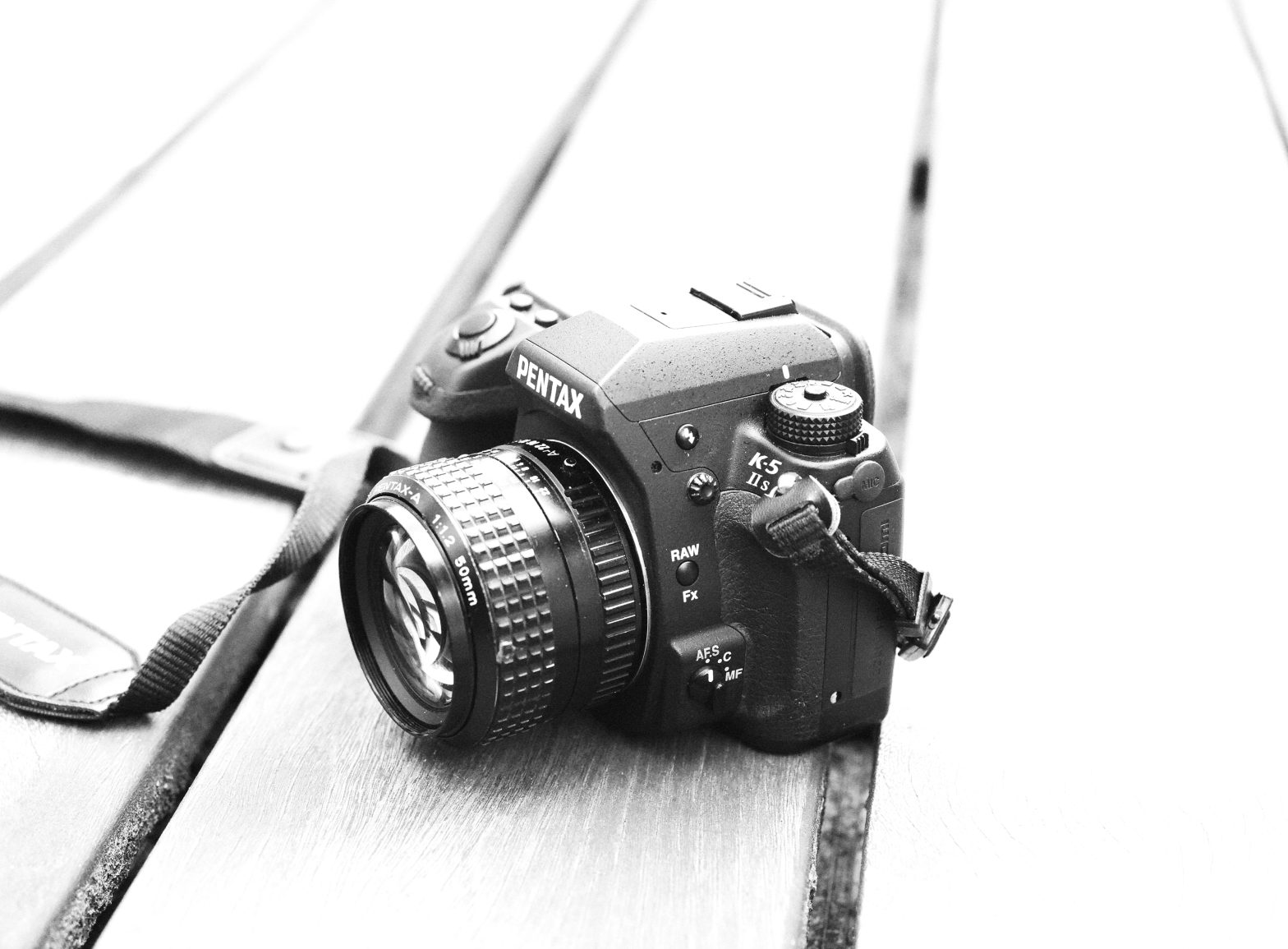
Back to Pentax: The K5 II s
As mentioned in my review of the Pentax 77mm f/1.8 limited, that lens became my go-to combination for many years, mounted on a Pentax K5. For long stretches it was pretty much the only lens I used.
The K5 slowly wore out. First the SD card slot, then the USB port, and in December 2023 I switched to a Nikon D3.
Recently, I got a K5 II s, which I have spent a good deal of time with this summer.
I have been using it with two manual-focus lenses: the Carl Zeiss 35mm f/2 distagon in ZK mount, and the Pentax SMC-A 50mm f/1.2, reportedly the fastest lens Pentax has made to date.
Everything Sits Where It Should
Everything sits where it should: aperture, ISO and the rest fall directly under the fingers via the two control wheels, with no firmware gymnastics required unlike the K10D, which needed an upgrade to map ISO to a wheel.
Like the 77mm, the K5 II s more or less disappears in use. It is a pleasure to work with.
What the ‘s’ Stands for
The K5 II s is the variant of the K5 II that omits the anti-aliasing filter in front of its 16.3 megapixel APS-C CMOS sensor. In return for a risk of moiré, the files come out noticeably more crisp.
Sony Sensors, Again
As with the K10D and the Nikon D200, there is a Sony connection: the K5 family is built around the 16.3 megapixel Sony IMX071, the same chip that sits in the Nikon D7000.
Different bodies, different colour science, same silicon; with the ‘s’ removing the low-pass filter from the equation.
Two Points Ahead of Its Successors
On DxOMark, the K5 II s scores 82. Its successors do not beat it. The K-3 and the K-3 II both land at 80; the K-3 III was never tested, DxOMark having stopped measuring dedicated camera sensors a couple of years before it arrived in 2021.
The two points come down to base ISO. The K5 II s drops to 80, in practice nearer 70, and buys a little dynamic range there; the K-3 pair start at 100. That is the whole of the gap.
It is worth reading for what it is. The score says nothing about resolution, where the 24-megapixel K-3 bodies pull clearly ahead, and nothing about Pixel Shift. Same measurement, different questions; the older sensor wins the one DxOMark happened to score.
If the score is what you’re after, the Pentax K-1 is the one to reach for. At 96 it clears every APS-C Pentax by a wide margin, the K5 II s’s 82 included, and it does so without giving up the things that make these bodies worth carrying: weather sealing, in-body stabilisation, a pentaprism finder, five decades of K-mount glass.
I liked working the the K1, but found it to computer-like back in December 2024, but I might give it a chance again in the future. I’d like to try the 645D too.
Compared to the Nikon D3 & D4
The K5 II s was released in 2012, the same year as the Nikon D4, and the two resolve almost identically: 16.3 megapixels (APS-C) against 16.2 (full frame).
The difference lies in the scale of the machinery, roughly 760 grams against the D4’s 1,340, before you add glass.
The D3, from 2007, offers 12.1 megapixels and, like the D4, that almost military-grade build.
The full-frame Nikons pull ahead at high ISO and in autofocus (51 points against the Pentax’s 11), while the K5 II s answers with in-body Shake Reduction; something Nikon never built into its DSLRs, plus weather sealing and a 100% pentaprism viewfinder in a much smaller package.
Compared to the K10D & *ist DS
Seen against its CCD ancestors, the Pentax *ist DS from 2004 (6.1 megapixels) and the Pentax K10D from 2006 (10.2 megapixels), the K5 II s is a different kind of instrument: ISO 80–51200 against the K10D’s 100–1600, seven frames per second against three, 1/8000 of a second against 1/4000.
What you give up is the CCD tonality, the painterly quality I have compared to tube amplification elsewhere. The K5 II s is the solid-state alternative: cleaner, faster, more resolving, and very good at what it does.
In Brief
Somewhere between Christensen’s 2.3 kilo 67 II and the 6 megapixel *ist DS sits the K5 II s: compact, weather-sealed, unfiltered, with five decades of K-mount glass behind it.
Everything sits where it should. It is a pleasure to work with.
Pentax K5 II s Specifications
- Release date: September 2012
- Sensor: 16.3 megapixel APS-C CMOS (23.7 × 15.7 mm), no anti-aliasing filter
- Max resolution: 4928 × 3264 pixels
- ISO range: 100–12800 (expandable 80–51200)
- Continuous shooting: 7 frames per second
- Shutter speed: 30 sec – 1/8000 sec
- Autofocus: SAFOX X, 11 points (9 cross-type), sensitive down to −3 EV
- Viewfinder: Pentaprism, 100% coverage, 0.92x magnification
- Screen: 3 inches, 921,000 dots
- Image stabilization: In-body Shake Reduction (SR)
- Build: Magnesium alloy over a stainless steel chassis, weather-sealed
- Memory card: SD / SDHC / SDXC
- Battery: D-LI90 (shared with the K5)
- Mount: Pentax KAF2 — backwards compatible with decades of K-mount glass, including the SMC-A 50mm f/1.2
- Weight: approx. 760 grams with battery and card
