In 2011 I wrote a system poem. In 2024 I inscribed it into the Bitcoin blockchain. In 2025 I finished a photography-based work, ICE | July | 1982, built around the idea of William Gibson’s Black ICE: the membrane that, in Neuromancer, protects data against intrusion.
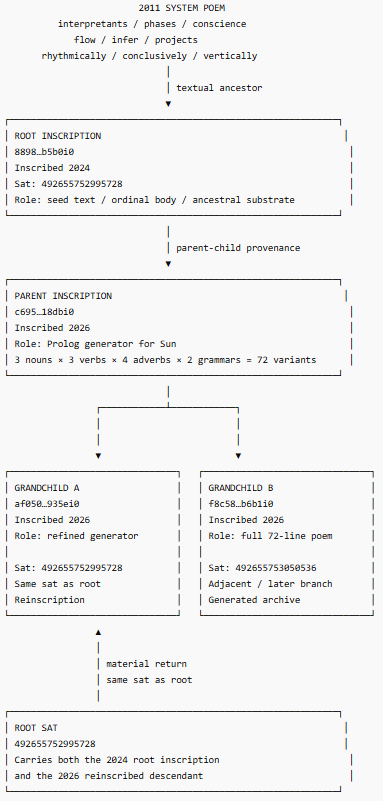
In 2026 I returned to the same poetic structure with Sun: Triptychs for Solar Eclipses, which is a generative work keyed to 72 solar eclipses predicted in Saros 126.
The system poem’s format was inspired by structural linguistics, primarily Roman Jakobson’s notion of two linguistic axes – the paradigmatic axis of selection, running vertically; and the syntagmatic axis of combination, running horizontally.
—
interpretants / flow / rhythmically
phases / infer / conclusively
conscience / projects / vertically
—
walk-through / assimilate / authenticate
dichotomise / diurnally / referentiate
refer / transfer / illuminate
—
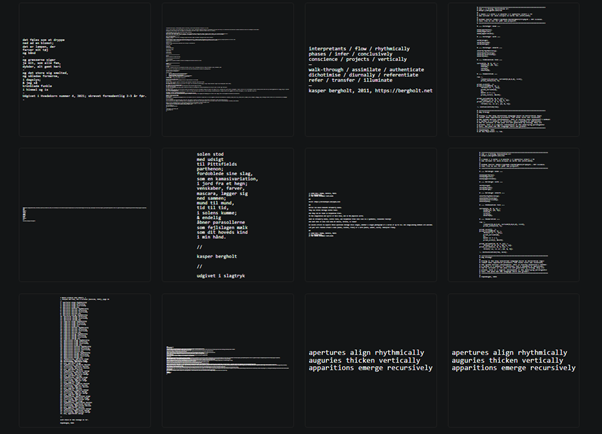
The 2011 System Poem
The first poem, beginning with interpretants, phases, conscience, would theoretically generate 216 distinct variants if the noun phrases were harmonised to a uniform number, whether singular or plural, in an adverb-last configuration, and another 216 in an adverb-first configuration.
As it stands, however, the poem is a structure that can only produce twelve grammatically congruent sentences before agreement breaks down.
The 2024 Blockchain Inscriptions
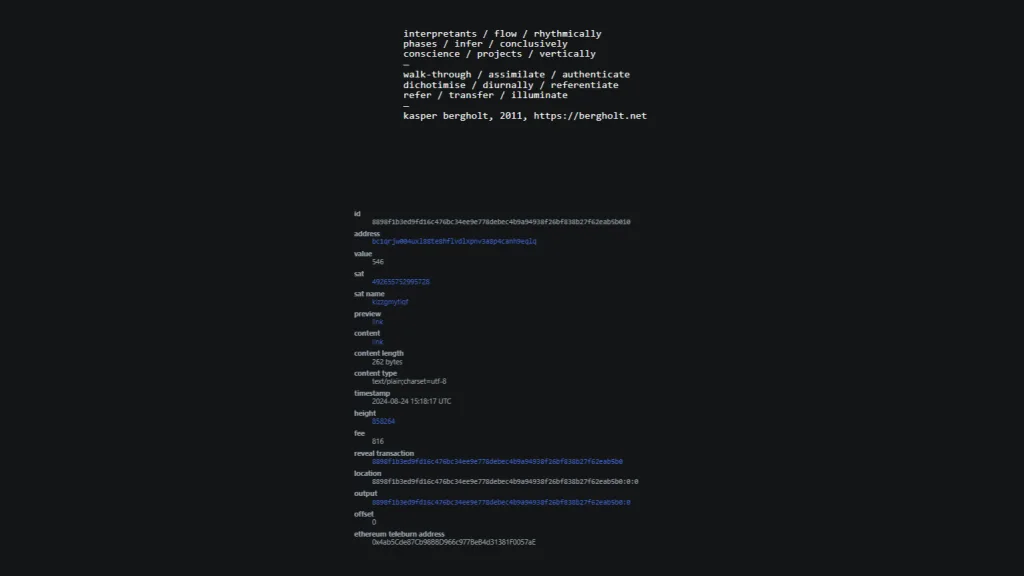
In 2024, I inscribed the 2011 poem into the Bitcoin blockchain using the Ordinals technology.
Thematically, the poem is not about Bitcoin or any other cryptocurrency, and it was not originally written for the medium of Ordinals, since that technology was not available in 2011.
The focus is on practical permanence: giving the poem a semi-permanent cryptographic address by inscribing it into what I think is the most widely globally distributed ledger.
The gesture also connects to Jacques Derrida’s engagement with writing, traces, archives and archiving, inscription, exergues, and the challenge to the idea that speech is more authentic than writing.
Inscription Lineage
Permanence: Shakespeare, Wordsworth
« When a reader understands that the first line can be read taking “a slumber” as a predicate noun and “my spirit” as the subject of a second, syntactically nonstandard sentence, a completely different interpretation can suddenly loom. Instead of an experience of confusion, an unnerving yet stark clarity may very well characterize one’s introduction to this third way of reading. If “my spirit” “did . . . seal” “a slumber,” then the speaker seems by no means slumbrous, insensitive, and imperceptive. He marks, closes, impresses, or enforces a slumber, though the passive recipient of this action is yet undeclared. The speaker now appears to be an active agent, an executor of deeds, rather than a passive undergoer of his own vicarious death fantasy or an insensitive and belated mourner of lost love.»
— Brian G. Caraher, Wordsworth’s “Slumber” and the Problematics of Reading (University Park, PA: Pennsylvania State University Press, 1991), 45.
—
Permanence and impermanence are recurring themes in poetry. Two of my favourites are Shakespeare’s Sonnet 18 and William Wordsworth’s A Slumber Did My Spirit Seal.
A Slumber Did My Spirit Seal offers a stark model of permanence: not preservation through writing, but absorption into natural process, if the poem is read as expressing a belief in or sense of pantheism.
The dead beloved is no longer touched by “earthly years,” yet is rolled round in earth’s diurnal course with rocks, stones, and trees.
Shakespeare, in Sonnet 18, imagines poetic language itself as a technology of endurance: “So long lives this, and this gives life to thee”, where “this” is conventionally taken to refer to an entity consisting of the work, the verse, the sonnet, the 14 lines, not to the plurality of individual lines on the page: deixis without an intratextual antecedent.
Also See: Objects for an Ideal Home
A Slumber Did My Spirit Seal
A slumber did my spirit seal;
I had no human fears:
She seem'd a thing that could not feel
The touch of earthly years.

No motion has she now, no force;
She neither hears nor sees;
Roll'd round in earth's diurnal course,
With rocks, and stones, and trees.
Wordsworth wrote the poem in Goslar, in Lower Saxony, during the winter of 1798–99. He and his sister Dorothy had travelled to Germany with Samuel Taylor Coleridge that autumn, but the party separated on arrival: Coleridge went on to Ratzeburg, the Wordsworths to Goslar, where they spent an unusually hard winter with few books and no company.
He sent the poem to Coleridge by letter in December 1798. It was first published two years later, in volume II of the 1800 Lyrical Ballads.
The poem never names Lucy. It is counted among the Lucy poems because Wordsworth placed it directly after “She dwelt among the untrodden ways”, not because of anything in the eight lines themselves.
Versus Shakespeare’s Sonnet 18
The structure of the Bitcoin poem contrasts with standard English metrical lines. It favours short, loose, four-syllable structures, unlike A Slumber Did My Spirit Seal, which moves between iambic tetrameter and iambic trimeter.
Shakespeare’s Sonnet 18, by contrast, consists of fourteen lines of iambic pentameter, though the exact count depends on the pronunciation of words such as temperate, ow’st, wander’st, and grow’st.
Inscription Data
Inscription number: #74,857,184 (plain text version archived on ordiscan.com)
Inscription ID: 8898f1b3ed9fd16c476bc34ee9e778debec4b9a949…eab5b0i0
Owner: bc1qrjw0…anh9eqlq
Content size: 262 bytes
Sat number: 492,655,752,995,728
Creation date: August 24, 2024, 5:18 PM
Creation transaction: 8898f1b3…62eab5b0
Creation block: 858,264
Sat 492,655,752,995,728 is not just metadata; under ordinal theory it is the satoshi’s mined position since genesis. It places the inscription within a finite ordinal field of 2.1 quadrillion possible satoshi positions, just as the forty-eighth eclipse places the poem within Saros 126. The poem is therefore indexed twice: astronomically by eclipse sequence, and cryptographically by sat sequence.
Blockchain Inscription Versus NFTs
Many digital artowkrs on other blockchains, such as Ethereum, do not store the artwork file directly in the blockchain. Instead, they store a token and metadata that point to where the art is stored, often on decentralised storage such as IPFS.
Bitcoin Ordinals are notable because they generally involve inscribing the content itself directly into the data of a Bitcoin transaction.
Earlier Blockchain-based Artworks
Bitcoin Ordinals were used by Chinese artist Yue Minjun for Human in May 2024.
In his art, Yue Minjun reinterprets significant historical and cultural events, including the moon landing, Woodstock, and Delacroix’s Liberty Leading the People.
Neuromancer and Unauthorized Images
One footnote. Neuromancer was published in 1984 and went unfilmed for forty-two years, from publication until Apple’s ten-episode adaptation, which premieres on 22 January 2027. Options came and went in between; adaptations were announced and abandoned.
For those forty-two years the novel’s images — cyberspace, the Sprawl, black ICE — circulated only through other people’s work: The Matrix, Ghost in the Shell, a long tail of imitations, and four decades of paperback covers.
None of it was authorised. A book that gave a generation its picture of cyberspace had no picture of its own.
Appendix: Etymological Glossary
- Assimilate — Latin ad- (“to”) + similis (“like”); absorb and integrate.
- Authenticate — Greek authentikos (“genuine”); verify as real or true.
- Conscience — Latin con- (“with”) + scire (“to know”); moral awareness.
- Dichotomise — Greek dichotomia (“cutting in two”); divide into two parts.
- Diurnally — Latin diurnalis (“daily”), from dies (“day”); recurring once each day. In earth’s diurnal course, the planet’s daily rotation, not the daytime. The same diurnum gives Old French jorn, and so journal (a day-book) and journey (a day’s travel)
- Flow — Old English flōwan; to move smoothly or continuously.
- Illuminate — Latin illuminare (“to light up”); to clarify or enlighten.
- Infer — Latin in- (“in”) + ferre (“to carry”); derive logically.
- Interpretants — Latin interpres (“interpreter”); meaning generated by a sign in Peircean semiotics.
- Line — Latin linea (“a linen thread”), from linum (“flax”); in classical Latin already a cord, a plumb-line, a boundary, and a line of descent. Latin linea renders Greek γραμμή (grammḗ, “line”), which stands beside γράμμα (grámma, “letter”) not as its parent but as its sibling, both formed from γράφειν, “to scratch, incise, write”. The road from Derrida’s De la grammatologie (1967) back to flax therefore runs through translation rather than descent: a science of letters that Latin could only have called a science of threads.
- Lineage — same root, via Old French lignage.
- Phases — Greek phasis (“appearance”); stages in a process.
- Projects — Latin proicere (“throw forward”); planned work, or to extend outward.
- Refer — Latin referre (“carry back”); to mention or relate.
- Referentiate — From referent + -iate; to treat as a referent.
- Rhythmically — Greek rhythmos (“measured flow”); in regular beats.
- Transfer — Latin trans- (“across”) + ferre (“carry”); move from one place to another.
- Vertically — Latin vertex (“top, turn”); upward or perpendicular movement.
- Walk through — Old English wealcan (“roll”) + þurh (“through”); a step-by-step guide.
Appendix: Glossary for A Slumber Did My Spirit Seal
- Slumber — Old English slumerian, related to sleep; light or gentle sleep.
- Spirit — Latin spiritus (“breath, soul”), from spirare (“to breathe”); life force or soul.
- Seal — Latin sigillum (“small signet”), diminutive of signum (“sign”); to close or fix.
- Human — Latin humanus; of or relating to mankind.
- Fears — Old English fǣr (“sudden danger”); anxiety or dread.
- Thing — Old English þing (“assembly, entity”); object or concept.
- Touch — Old French touchier, from Vulgar Latin toccare; to make physical contact.
- Earth — Old English eorþe; ground, soil, world.
- Years — Old English gēar; unit of time.
Paratexts: Bloom & Deridda
« Wordsworth invented modern poetry in English. Before him, the poet could cultivate subjects outside the self. After Wordsworth, the poem is the man or woman who composes it. »
— Harold Bloom
« All of Wordsworth turns upon his vision of “intimations of immortality.” A transcendental naturalism, whether in Wordsworth or Emerson, is now difficult to comprehend, as we are post-Darwinian, post-Freudian, and post–quantum mechanics. The simplest and perhaps most accurate sense we can give to Wordsworthian “immortality” is its return to the childlike condition of having no consciousness of death. »
— Harold Bloom
« The archivist produces more archive, and that is why the archive is never closed. It opens out of the future. »
— Jacques Derrida
Were the Poems Written by AI
None of the poems presented on this page were generated by AI.
As Long as Sand by the Sea: Tibirke, 1738
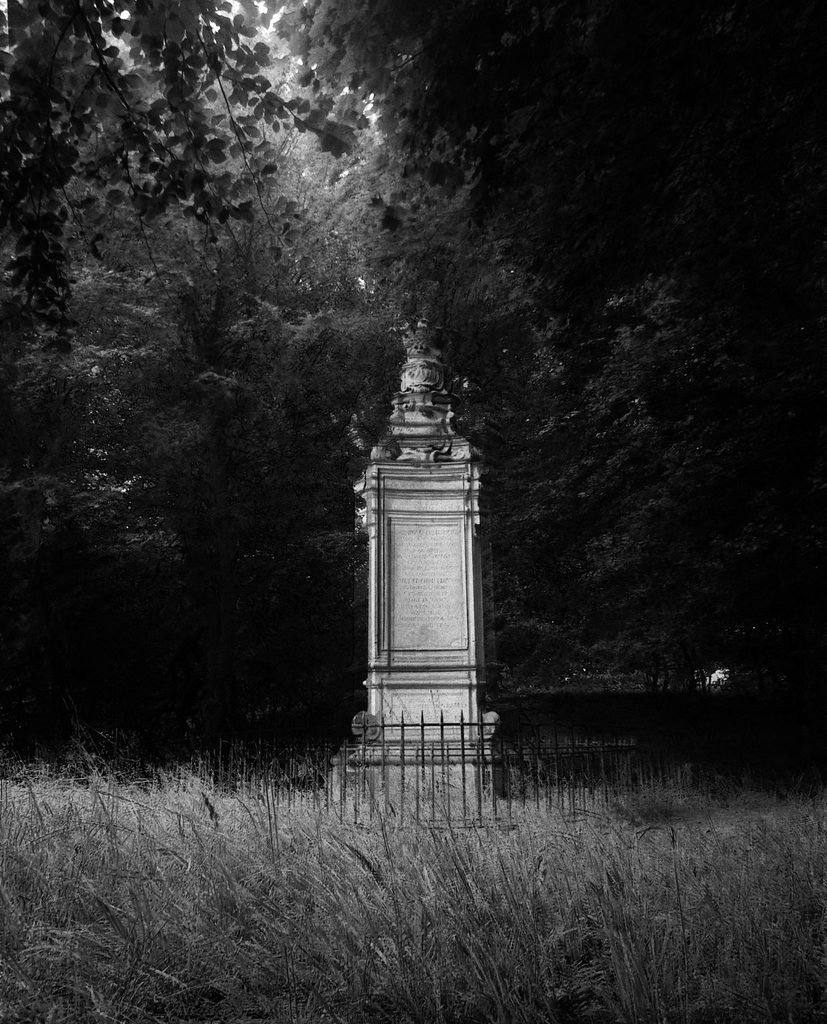
On a small hill at Tibirke, Tisvilde, Denmark stands a sandstone monument, raised in 1738 to mark the end of two centuries of sand drift that had buried streams, fields and whole villages in the area.
It is plainly artificial: baroque volutes, a crown, a royal orb, set down in a landscape that looks natural and is not.
The forest close to it, Tisvilde Hegn, was planted to hold the dunes. Today it is fredet, protected, from fred: a land put at peace after a long war with the wind.
The monument gives surface to three different languages, and they do not say the same thing. The Danish, by the priest Jørgen Friis, rhymes in plain couplets and wishes the king’s line to endure saa længe … som mand kand støf og sand omkring ved hafvet faae, “as long as dust and sand can be found around the sea.”
It is the same formula as Sonnet 18, “So long lives this,” with sand in place of breath. The German, by Andreas Hojer, turns to the passer-by, Schau, Leser, calls the land ein Meer von Sand, and wishes the royal line to become wie der Sand am Meer und unvergänglich: an Abrahamic promise, endurance counted in grains rather than years.
The Latin text, the most factual of the three, is lost under moss.
In 2026 I returned to the monument with snd-drft, a demo for MS-DOS based on fresh photos of the different sections of the Sand Drift Monument, connecting four different time-lines in an attempt at fixing everything in one chronotopic payload.
It reads the surviving faces letter by letter: horizontally as a story, vertically as sound, each letter a partial of 110 Hz. See the full inscriptions and translation here.
